A repository of commentary and resources for aspiring archivists
is the Bentson Archivist and Assistant Curator of the Moving Image department of the Walker Art Center , where she oversees the preservation of the Ruben/Bentson Moving Image Collection. She also serves on the Board of Directors of Canyon Cinema, a foundation in San Francisco dedicated to education and access to artist-made films. She holds a B.A. in Media Studies from UC Berkeley and is a graduate of UCLA’s MLIS program.
is a graduate of San Jose State University's MLIS program and currently works in Washington state as an Information Literacy and Reference Librarian for a university in Seattle. Previously, he worked as an Archivist and Electronic Resources Librarian for St. Martin’s University. As an electronic resources librarian, he manages the process of selecting, acquiring, and activating electronic resources, as well as receiving physical resources.

As archivist and Assistant Curator of the Walker's Moving Image Department, Patricia manages the Bentson Archive and curates the collection, in tandem with the Head Curator who is Patricia’s direct supervisor. Patricia oversees the preservation of the collection, but also programs and activates it within the Walker and outside of the institution. Her role includes recommending and making acquisitions for the Moving Image Collection.
Another great way to get a sense of the day-to-day of archival work is to periodically read current job descriptions, even if you aren't actively seeking a job. Here are a few sample job listings we thought sounded interesting, at various organizational levels:
This is a great entry-level position, offering the opportunity to aid artists-in-residence in their research. The job description provides context on DAMS and CMS one might encounter on the job.
Entry-mid career position in film and digital photo preservation, providing research services and exhibition planning for all things MTA!
As an Information Literacy Liaison, Rhian collaboratively designs curriculums to incorporate information literacy programming into departmental or class structures, creating a sustainable, efficient, and cost-effective preservation environment for historic university materials. His archivist duties were divided into three main parts: patron interactions and outreach, office work and meetings, and processing archival material by identifying priorities.
This is a senior level position which requires several years of field and team management experience. Extensive technical skills including metadata vocabularies, integrated library systems platforms, and other applications such as Airtable.
This job does not have a minimum requirement for years of experience but does ask for familiarity with XML, Dublin Core, the Ethnographic Thesaurus, and ArchiveSpace to support digital preservation initiatives. The job also entails writing grant proposals, conducting outreach, and tending to reference requests.
AMIA hosts information about scholarships, fellowships, mentorship programs, as well as free webinars, literature, & lectures on their site. Patricia has been involved with AMIA since grad school, attending the annual confreneces & writing for their journal.
Probably the least appreciated or understood media format is audio, meaning specializing in audio archiving is a rarified skillset. ARSC has a complete archive of all their past conferences on their site if you’re hoping to learn more about audio archiving.
FIAF is the international equivalent of AMIA, but focuses solely on film. They host an annual symposium as well as a highly regarded film restoration summer workshop in Bologna, IT.
The Flaherty started as the archive of the first documentary filmmaker but has evolved into an organization hosting seminars and residency programs for filmmakers and curators. This is an organization we learned about through Patricia, who will be attending this summer's curatorial seminar.
Words of Mouth is a weekly newsletter sharing opportunities for professional and creative development across design, the arts, education, and information. In addition to employment opportunities, it also lists fellowships, residencies, funding, and publication opportunities, with an archive of previous weeks' newsletters to search through on the site. It was started by Rachel Meade Smith, a writer, researcher, artist, and learning designer focused on civic design and knowledge sharing projects.
ACRL site offers access to information literacy LibGuides, academic library advocacy toolkits, scholarly publications, and information about conferences for professional development opportunities.
ARL represents major research libraries across North America. Their website contains resources covering digital preservation, data management, scholarly communication, and even houses job listings and webinars. ARL hosts confrences thoughout the year, including the annual Library Assesment Confrence and IDEAL, a confrence about inclusion, diversity, equity & accessibility in research library contexts.
PNLA offers regional networking opportunities, professional development events, conferences, and a listserve with job postings for the Pacific Northwest. Visitors can find resources on library management, collection development, and emerging trends specific to the Pacific Northwest.
AASL's website aids librarians and information professionals seeking to expand their network in accessing and sharing educational and professional development resources with peers in the field of architectual librarianship.
Archives Gig is a Wordpress website created by Meredith Lowe, an MLIS graduate from the University of Madison, WI, because, "The archives job market has fascinated me since my graduate career, and this is a way for me to give back to a profession that I love". Jobs are organized by date, region (international, too) and specialization. There is also a mailing list to get the latest listings in your inbox.
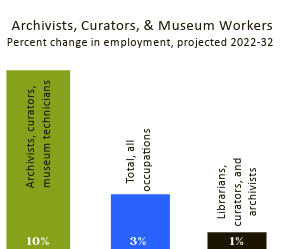
The employment outlook for archivists, curators, and museum workers is promising, with a projected growth rate of 10% from 2022 to 2032, significantly faster than the average for all occupations. On average, about 5,000 openings per year are expected over the decade, with many stemming from the need to replace workers transitioning to other occupations or retiring from the workforce.
The demand for archivists is projected to rise due to the increasing volume of information and records in both public and private organizations, particularly with the growing prevalence of electronic records. Similarly, the continued public interest in museums and cultural centers is anticipated to drive up demand for curators, museum technicians, and conservators. However, changes to the federal budget may affect archives and museums receiving federal funds, potentially impacting the employment of archivists, curators, museum technicians, and conservators.
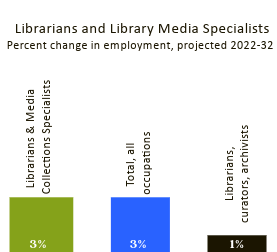
Employment prospects for librarians and library media specialists are expected to increase modestly, with a projected growth rate of 3% from 2022 to 2032, aligning closely with the average for all occupations. Annually, an estimated 13,700 openings for librarians and library media specialists are forecasted over the decade, primarily driven by the need to replace workers transitioning to other professions or retiring from the workforce.
Libraries continue to require librarians to oversee various services and activities. Librarians are essential for managing libraries and assisting patrons in finding information. Library patrons are anticipated to remain engaged by attending events and utilizing other services, including child-focused activities and employment assistance.
Since digitization of moving-image material has become so integral to access and preservation, employers in the field are increasingly looking for candidates with experience in digital forensics, data recovery, and museum digitization initiatives more broadly. Familiarity with cultural heritage preservation practices is also in demand, as well as strategies for how to engage audiences in education and programing initiatives. Another helpful skill to have is familiarity with machine learning and artificial intelligence for media analysis.
Increasingly important are skills around large data set management, analysis, and visualization with tools such as Tableau. As emerging forms of media enter the archive, it is also important to stay up to date on new digital preservation techniques. There is also an increasing demaind for candidates knowledgeable in copyright and intellectual property rights in academia.
Patricia's top recommendations for classes to take during your MLIS program:
Neither of our information professionals completed internships during their MLIS programs. Patricia was still working for Canyon Cinema remotely and programming Lightfield, an annual exhibition of recent and historical moving image art on celluloid. As long as you are actively involved in your field and gaining experience, that's what matters.
Rhian encouraged MLIS students to take advantage of as many technical skills classes as possible, being intentional to take ones that would be applicable to both archiving and librarianship, like coding and server maintenance. But his favorite class from his MLIS was a class called Issues in Academic Librarianship:
We have unique backgrounds which aren't always conducive to certain methods of gaining experience. Rhian spoke of being an adult student with a newborn daughter:
The Covid-19 pandemic highlighted the limitations of DEI efforts in addressing systemic inequalities within these fields. DEI initiatives often fail to address issues such as fair compensation, job security, and power imbalances within institutions. Many information science (IS) professionals, such as curators and archivists, have begun to create their unions and communities in response to politics, layoffs, and power imbalances over the past four years.
Among these communities, salary sharing has become one of the biggest practices in curatorial and librarianship circles. This fosters transparency and empowers workers to advocate for fair compensation based on industry norms and individual qualifications. Much of this sharing and collaborative conversation about work experiences takes place on social media, making these professions more interconnected and visible to the public.
The second trend most discussed by IS professionals is AI. When AI became prominent last year, it seemed to cause mass hysteria that it could replace almost all jobs. However, many information science professionals believe otherwise, suggesting that instead, AI might enhance and provoke larger conversations about trust, transparency, and bias in information systems.
The Carpentries is a community of researchers, teachers, and information professionals who have organized free educational cirricula and resources on data and coding skills. From scripting to webscraping to SQL, their site contains over 4,100 archived workshops broken down into three categories: Data, Library, and Software skills. This site was strongly recommended by Patricia as a way to keep on top of your technical skills.

The Museum of Modern Art's Media Conservation Department has an incredibly comprehensive website documenting their Media Conservation Initiative, which is packed with theoretical and technical skills videos for those interested in the particular challenges of preserving media based artworks. The site has lectures on caring for artists' films, the history of disk imaging, metadata and checksums from a museum archival standpoint, and many more, along with case studies and templates for license agreements and pre-acquisition questions.

LACMA hosted an amazing colloquiem which brought together AV archivists, artists, curators and technicians in Oct. 2023, addressing contemporary themes and issues around archving and presenting multimedia and moving-image artwork. The colloquiem can be viewed in its entirety here.

The Society of American Archivists (SAA) is a professional organization dedicated to advancing the field of archival science and promoting the interests of archivists in the United States. Their website serves as a central hub for archivists, offering valuable resources, information, and networking opportunities. It also provides archivists access to a wide range of resources essential for professional development, including best practices, guidelines, and standards for archival work. Archivists can also find information about upcoming conferences, workshops, and events hosted by SAA, as well as job listings and career resources. Additionally, the website offers access to publications, such as journals and newsletters, that cover topics relevant to the archival profession.

The Society of California Archivists (SCA) is a professional organization dedicated to promoting the interests of archivists and archival institutions in California. Their website informs about advocacy efforts and legislative laws impacting archives. It provides access to a variety of resources tailored to the unique needs of archivists in California. This includes information on local events, workshops, and conferences relevant to the archival community in the state. Archivists can also find resources specific to California archival collections, preservation techniques suited to the region's climate, and legal guidelines relevant to archives in the state. Additionally, the SCA website offers access to professional development opportunities, such as webinars and training sessions, as well as networking opportunities through member directories and forums.